There’s one thing that causes more retaining wall drainage failures than anything else, and it’s not the wall itself. It’s water.
Retaining wall drainage on the Gold Coast is one of the most important parts of any wall build, yet it’s also one of the most commonly skipped. With heavy summer storms, fast runoff on sloping blocks, and soil that stays saturated for days after rain, a wall without proper drainage is a wall on borrowed time.
Whether you’re a homeowner in Mudgeeraba, a developer working on a site in Robina, a builder, a landscaper, or a property manager, understanding how drainage works behind a retaining wall can save you thousands in repairs and replacements.
This guide covers what retaining wall drainage actually does, what a proper system includes, the shortcuts to avoid, and how to make sure your wall is built to last.
Why Water Is a Retaining Wall’s Biggest Threat
Soil always exerts pressure against a retaining wall. That’s normal, and a well-designed wall can handle it. The problem starts when soil becomes saturated.
Wet soil gets heavier, expands, and pushes significantly harder against the wall. Water that has nowhere to escape builds up behind the wall and creates what’s called hydrostatic pressure, which is essentially the force of water pushing sideways against the structure.
Over weeks and months, that pressure causes walls to lean, bow outward, crack, and eventually fail. By the time the damage is visible, the problem has usually been building for a long time.
The good news is that proper drainage eliminates most of that risk entirely.
Gold Coast Conditions That Make Drainage Essential
The Gold Coast has its own specific conditions that make drainage more critical here than in many other parts of the country.
Summer storms can dump massive amounts of rain in a short time. On sloping blocks in areas like Tallebudgera, Reedy Creek, or the hinterland behind Mudgeeraba, water runs fast and heads straight downhill toward whatever is in its path, often a retaining wall. A single afternoon storm can create the kind of pressure behind a wall that you’d normally expect over several weeks.
Soil types across the region also vary a lot. Some areas have sandy, free-draining soil. Others have clay that holds water for days and becomes extremely heavy when wet. Two properties on the same street can behave completely differently after heavy rain.
Add in pools, paved entertaining areas, garden beds, and artificial turf, all of which are common on Gold Coast properties, and you end up with surfaces that stop water from soaking away naturally. That water has to go somewhere.
Without drainage, it goes behind your wall.
What a Proper Retaining Wall Drainage System Includes
A quality drainage system isn’t just a pipe thrown in as an afterthought. It’s a layered system where every component works together.
Free-Draining Gravel Backfill
Directly behind the wall, there should be a zone of gravel rather than soil. Gravel lets water move freely downward. Soil holds water and becomes heavy.
If a contractor backfills directly against the wall with soil, that’s a shortcut that leads to pressure problems. It might look fine initially, but after a few seasons of Gold Coast storms, the wall will tell the story.
Agricultural Drainage Pipe
An ag pipe is installed at the base of the gravel zone. Its job is to collect water moving through the gravel and carry it away from the wall to a safe discharge point.
This is one of the most important components, and one of the most commonly left out of cheaper quotes. It adds cost in materials and labour, which makes it an easy target for builders trying to win work on price alone.
Geofabric Filter Membrane
Geofabric sits between the native soil and the gravel backfill. Without it, fine soil particles gradually wash into the gravel during rain, slowly clogging the drainage system until it stops working.
A wall can look perfectly fine for a year or two and then start leaning once the drainage has blocked up. Geofabric is inexpensive insurance against a very expensive problem.
A Planned Discharge Point
This is the part most homeowners don’t think to ask about, and it’s where many drainage systems fall apart. The water collected by the ag pipe needs somewhere to go. That means a proper discharge point, whether that’s a connection to a stormwater system, a safe fall to a natural drainage area on your property, or approved soakage in suitable soil conditions.
Drainage should never be directed toward a neighbour’s property or left to pool at a fence line.
Weep Holes (Where Applicable)
Weep holes are small openings in the face of the wall that let water escape. They’re more common in block and masonry walls and can help reduce pressure in walls exposed to consistently high moisture. Not every wall needs them, but in the right situation they’re a useful addition.
Retaining Wall Material Comparison: Drainage Considerations
| Wall Type | Drainage Needs | Notes |
|---|---|---|
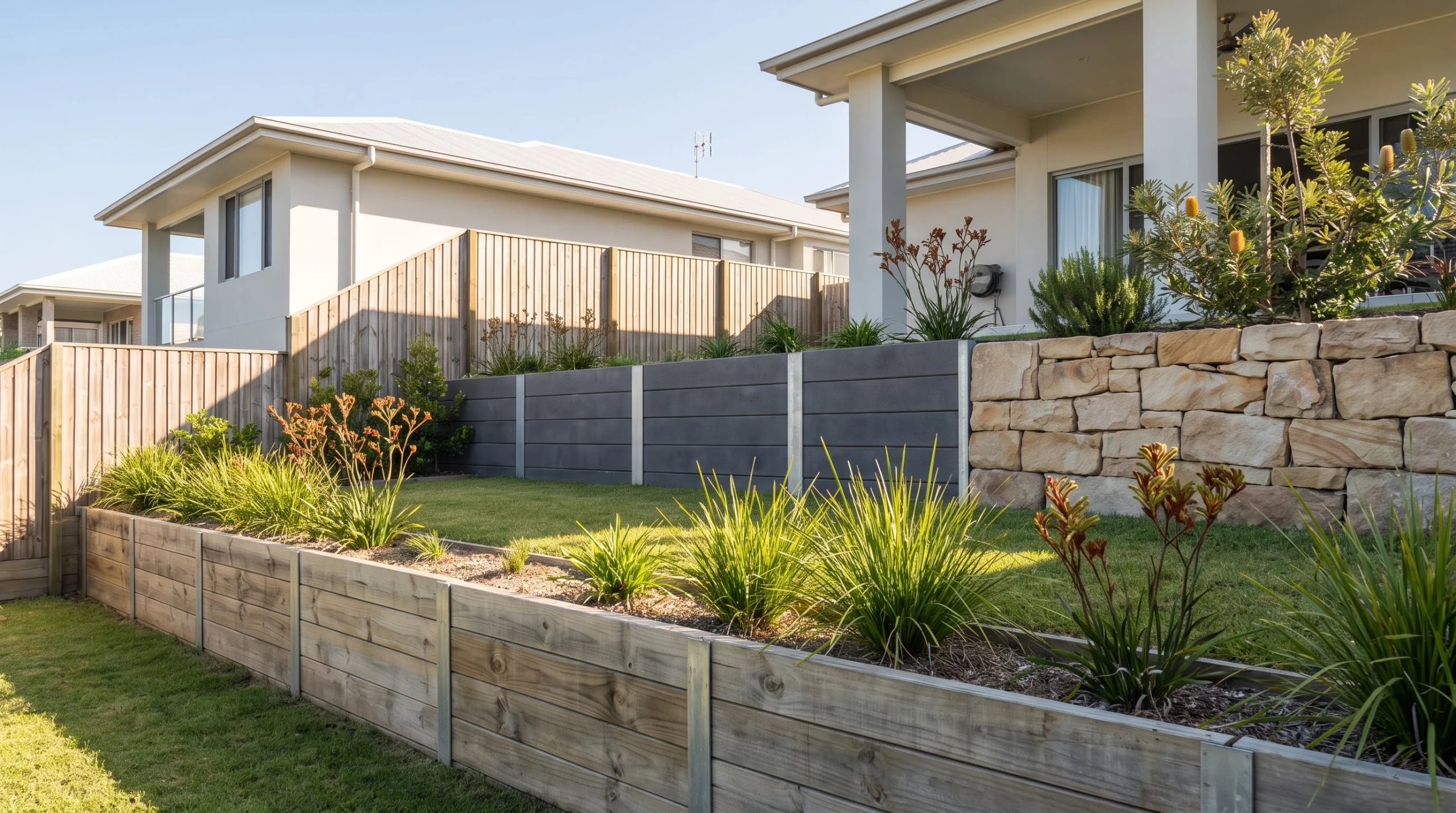
| Timber sleepers | High | Timber is porous but holds moisture; drainage protects longevity |
| Concrete sleepers | High | Impermeable face; drainage behind is critical |
| Besser block or masonry | High | Weep holes often included; gravel backfill still required |
| Gabion baskets | Lower | Inherently permeable; drainage naturally integrated |
| Segmental retaining blocks | High | Manufacturer spec often includes drainage requirements |
Red Flags to Watch for in a Retaining Wall Quote
When you’re comparing quotes for a retaining wall on the Gold Coast, drainage tells you a lot about the quality of what’s being offered.
Watch out for these warning signs:
- No mention of drainage at all in the quote or scope of works
- “We’ll backfill with soil” rather than gravel
- No geofabric included in the design
- No explanation of where the drainage pipe will discharge
- “A wall this size doesn’t need drainage”
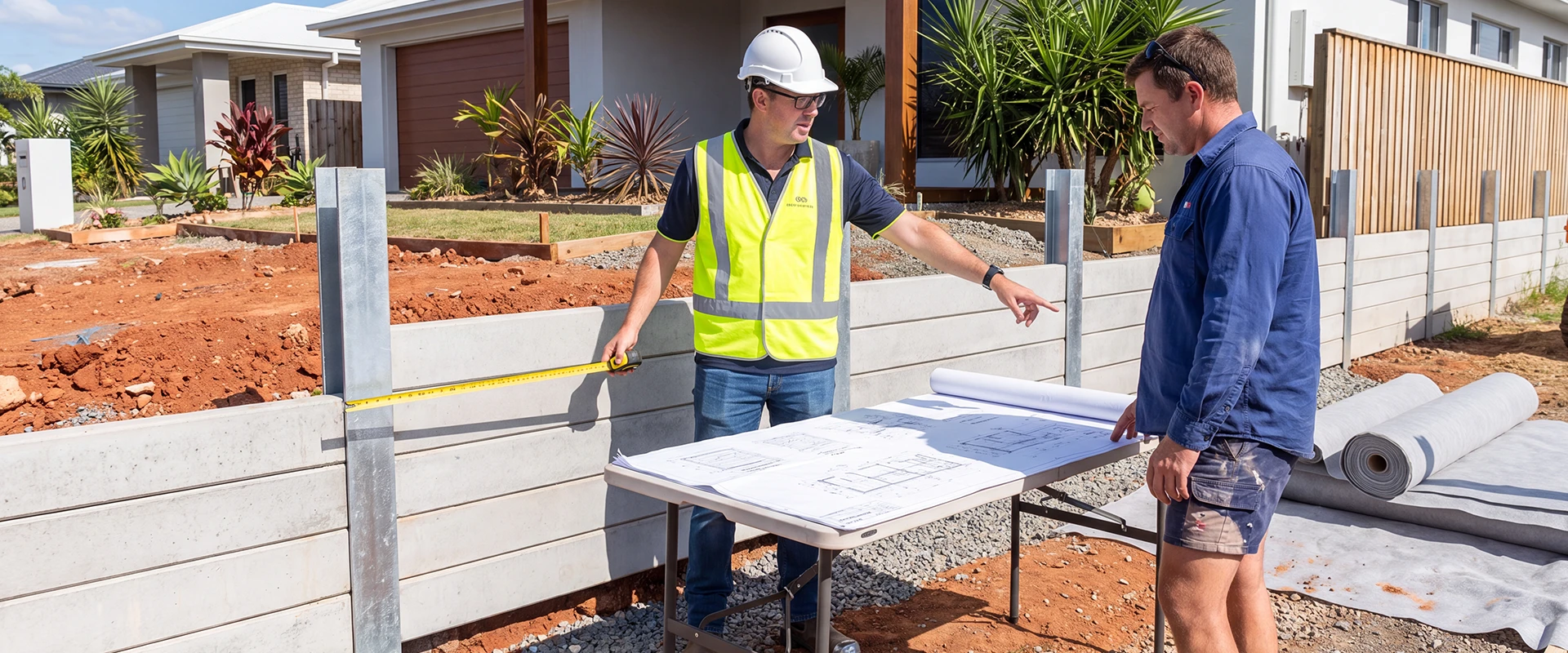
A professional builder should be able to explain the drainage system clearly, tell you what materials are included, and describe exactly where the water will go. If they can’t or won’t, that’s a problem.
If you’re unsure, we’re always happy to talk it through. That’s what we do every day at Goldie Retaining Walls, we couldn’t resist the shameless plug.
DIY vs Professional Retaining Wall Drainage
| Factor | DIY | Professional |
|---|---|---|
| Material cost | Lower upfront | Included in quote |
| Drainage design | Generic or guesswork | Site-specific to your block |
| Gravel zone accuracy | Variable | Engineered to wall height and soil type |
| Council compliance | Risk of non-compliance | Built to Queensland requirements |
| Outcome after storms | Unpredictable | Designed to handle local rainfall |
For low walls under 600mm on flat, well-drained blocks, a DIY approach can sometimes work. For anything on a slope, near a pool, or over 600mm in height, professional installation makes a significant difference in long-term performance.
Council Rules and Height Requirements in Queensland
In Queensland, retaining walls over 1 metre in height generally require council approval, and walls over 1.5 metres typically need to be designed by a Registered Professional Engineer of Queensland (RPEQ). You can check the specific requirements for your area at the Queensland Government’s planning portal.
Drainage is often part of what an engineer will assess when reviewing a wall design. Getting drainage wrong on a wall that requires engineering sign-off can mean the wall doesn’t pass certification, which creates significant delays and additional costs.
For a general overview of soil pressure and drainage principles that engineers work from, the Australian Geomechanics Society publishes technical guidance relevant to retaining wall design and site assessment.
Can Drainage Be Added After the Wall Is Built?
Sometimes, but it’s rarely straightforward or cheap.
Retrofitting drainage to an existing wall usually means excavating behind it, removing saturated soil, installing gravel, geofabric, and pipe, and then making good all the landscaping, turf, and paving that was disturbed in the process.
In most cases, it costs far more to fix drainage after the fact than it would have cost to include it properly during the original build.
How Drainage Fits Into Your Landscaping Plan
Drainage doesn’t exist in isolation. The way water moves across your property affects your garden beds, turf health, paving longevity, and where certain plants will thrive.
When you’re planning a retaining wall project on the Gold Coast, it’s worth thinking about your property as a whole. Where does water naturally flow on your block? Are there areas that stay wet after rain? How will the new wall change those patterns?
Doing the retaining wall, drainage, and landscaping as one coordinated project almost always delivers better results than tackling them separately.
Frequently Asked Questions About Retaining Wall Drainage
Does every retaining wall need drainage?
Most walls do, particularly in Queensland’s climate. Even low walls can trap water if they sit at the base of a slope, near irrigation, or in areas with clay soil. The risk increases significantly with wall height and rainfall intensity.
How deep should the ag pipe be behind a retaining wall?
The ag pipe is typically installed at the base of the wall footing, sitting within the gravel backfill zone. The exact depth depends on the wall design, footing depth, and site conditions. A professional will set this based on your specific build.
What is hydrostatic pressure and why does it matter?
Hydrostatic pressure is the force that water exerts sideways when it builds up behind a wall. It’s one of the primary causes of retaining wall failure. Proper drainage relieves this pressure before it can damage the structure.
How do I know if my existing wall has drainage problems?
Signs include the wall leaning or bowing outward, cracks appearing in sleepers or blocks, paving near the wall cracking or sinking, or soil washing out from behind the wall after rain. If you notice any of these, it’s worth getting a professional assessment before the problem gets worse.
Can I use a slotted pipe instead of ag pipe?
Slotted pipe and ag pipe refer to the same type of drainage pipe in most cases. What matters is that it’s the right diameter, correctly sloped toward the discharge point, and wrapped in geofabric to prevent clogging.
Get Your Retaining Wall Drainage Right From the Start
A retaining wall is only as good as the drainage behind it. Get that part right, and you have a structure that will handle Gold Coast storm seasons for decades. Get it wrong, and you’re looking at a repair job that costs more than the original wall.
If you’re planning a retaining wall project on the Gold Coast or surrounding areas, talk to a team that builds drainage into every job as standard, not as an optional extra.
Goldie Retaining Walls handles retaining walls, drainage planning, site preparation, and landscaping support across the Gold Coast region. Request a quote today or speak with one of our retaining wall specialists to find out what the right solution looks like for your property.